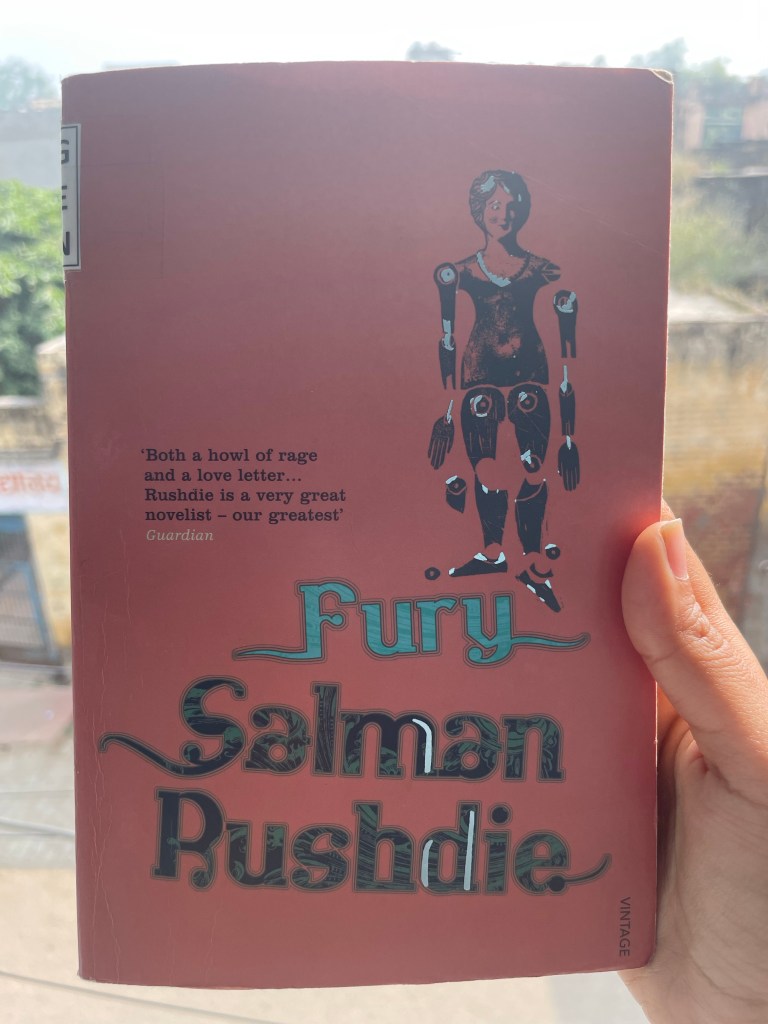
Despite hearing much about the Indian-British-American author, Fury was the first book I have read by Salman Rushdie. It is not one of his better known works – such as Midnight’s Children, which won the Best of the Booker Prize, or The Satanic Verses, which won him a fatwa from the Supreme Leader of Iran – but it was definitely interesting, particularly its anti-capitalist commentary and its creator-creation dialogue which forms a mise en abyme, en abyme.
Fury is a dark comedy that follows Malik Solanka, a retired academic and graduate of Cambridge University turned dollmaker, after he left his wife and child in the UK and moved to New York City. Solanka struggles with trauma that manifests as bouts of anger triggered by small events, loss of memory, and a fury that he is unable to control inside of him. Like many who struggle with forms of trauma and PTSD, his fury turns into fear of what he might do to the people around him during an episode.
This fear sends him across the Atlantic Ocean to New York City, the capital of the modern-day financial and social empire. He looks upon America with disdain for its ignorance of classical and cultural matters, but with the acceptance that here money trumps ideas. A self proclaimed historian of ideas, Solanka enters the belly of the beast with a supplication to be washed clean and consumed by the dominant culture. His diasporic, disdainful attitude lends itself to laughable and poignant opinions on American upper-class hypocrisy as well as colorful descriptions of everyday life and people in New York.
Fury takes on many forms in this 259-page novel. The main conflict is the dragon of anger that lives within Solanka. Fury turns into fear in the hearts and lives of supporting characters and residents of New York. The Furies themselves, or Erinyes, of Greek mythology circle around the city and show up as the professor’s three lovers. Pent up anger turns into political violence between two warring communities in a made-up literary world, representing the greater conflict between man’s poetic, communal side and its calculating, individualistic side.
In fact, this conflict is central to Rushdie’s commentary on art and capitalism. Solanka is a dollmaker who achieved Harry Potter-level success not once, but twice. His first creation being a female doll called Little Brain who takes on a life of her own, much to his dismay. As it does with most things, capitalism diluted the idea in order to then sell watered-down versions and variations. What the capitalist world sees as a major success, haunts Solanka like a lobotomized version of his own child.
Solanka’s second great success takes us into Rushdie’s hall of mirrors. His main character bears many similarities to himself – in education, demeanor, and marriage history. As Rushdie created Solanka, Solanka is in turn a creator of worlds. In his work the Puppet Kings, the aptly named Akasz Kronos is a father-creator to an army of humanoid robot beings. The robots all have personalities mirroring the supporting characters in Solanka’s life, with himself as the dollmaker made in the image of Kronos. The whole story is then adopted by a freedom movement in the country of Lilliput-Blefuscu, who undertakes a coup wearing the masks of the puppet kings. In the labyrinthine world of Rushdie-Solanka’s making, the lines between creator and creation merge and divide. Humans are dollified and dolls are humanized. Art bears no obligation to its artist, and life imitates art which imitates life and so on.
Add to this Solanka’s forays in love and sex. As is the case with many living with trauma, Solanka lives out altered versions of his trauma again and again. He is an incest survivor, revealed towards the end of the book, who recreated Oedipal situations in his life and work. His three main romances are marked with death, forbidden desire, and of course an erratic fury turned into a childlike fear. That is until he meets the perfect-in-every-way Neela, the ex of his murdered best friend, who allegedly heals him of the fire gnawing inside of him.
Neela bears an uncanny resemblance to Rushdie’s fourth wife, the beautiful Padma Lakshmi. As much as this book is an exploration of anger and capitalism’s corrupting effect on creation, I believe it is primarily a love letter to Lakshmi. Solanka and Neela are the only two characters in the book with a completely positive portrayal, and she is the one that redeems him in the end.
My main criticism of Fury is the same as that of most male-authored novels. The male protagonist has an engorged sense of importance which is then affirmed by their surroundings, particularly their effortless career success, financial comfort, and endless attention from beautiful women. This is particularly difficult to believe considering Solanka comes off as a bitter and out-of-touch old man – although that part may have been purposeful. Solanka shows no love for any place, and every non-Indian character ends up devoured by their own vices.
Books that Fury remind me of:
Everything is Illuminated by Jonathan Saran Foer for its comedic aburdism, bildungsroman/ pilgrimage aspects, as well as the writing style and depiction of family histories
Love in the Time of Cholera by Gabriel Garcia Marquez for its magic realist aspects, including the use of a made up country
The Da Vinci Code by Dan Brown for its unabashed male egocentrism
 Earth to Saniya